
2025 KCIC Sustainability Awards: Celebrating Environmental Leadership in Kansas City
The Kansas City Industrial Council (KCIC) hosted its annual Sustainability Awards breakfast in 2025, marking 15 years of recognizing businesses for their exceptional efforts in implementing sustainable practices across the Kansas City metro area. Susan Brown, president of KCIC's board of directors, welcomed attendees to the celebration.
As Brown emphasized during the event, supporting sustainable practices among Kansas City's businesses is simply good business. For 15 years, KCIC recognized businesses for their sustainability investments because these commitments—green in every sense of the word—deserved to be acknowledged and celebrated. The event was made possible through the generosity of sustaining sponsors: Evergy, the City of Kansas City, Missouri, and Kissick.
Featured Speaker: Courtney Tripp
Before the awards presentation, Courtney Tripp, Director of Sustainability and Strategy at Grundfos Industry Division, shared insights and experiences from her sustainability journey at Grundfos. With 20 years of experience driving purpose-driven growth and a deep passion for solving water and climate challenges, Tripp brought valuable perspective as a Certified Water Efficiency Professional who believed in the ability of innovations in industry and manufacturing to lead the way to a better, more resilient future.
2025 Award Winners
The morning's recipients represented businesses that embrace sustainability as a defining competitive advantage in today's business world. Seven organizations received six awards, recognizing sustainable practices implemented across the metro area.
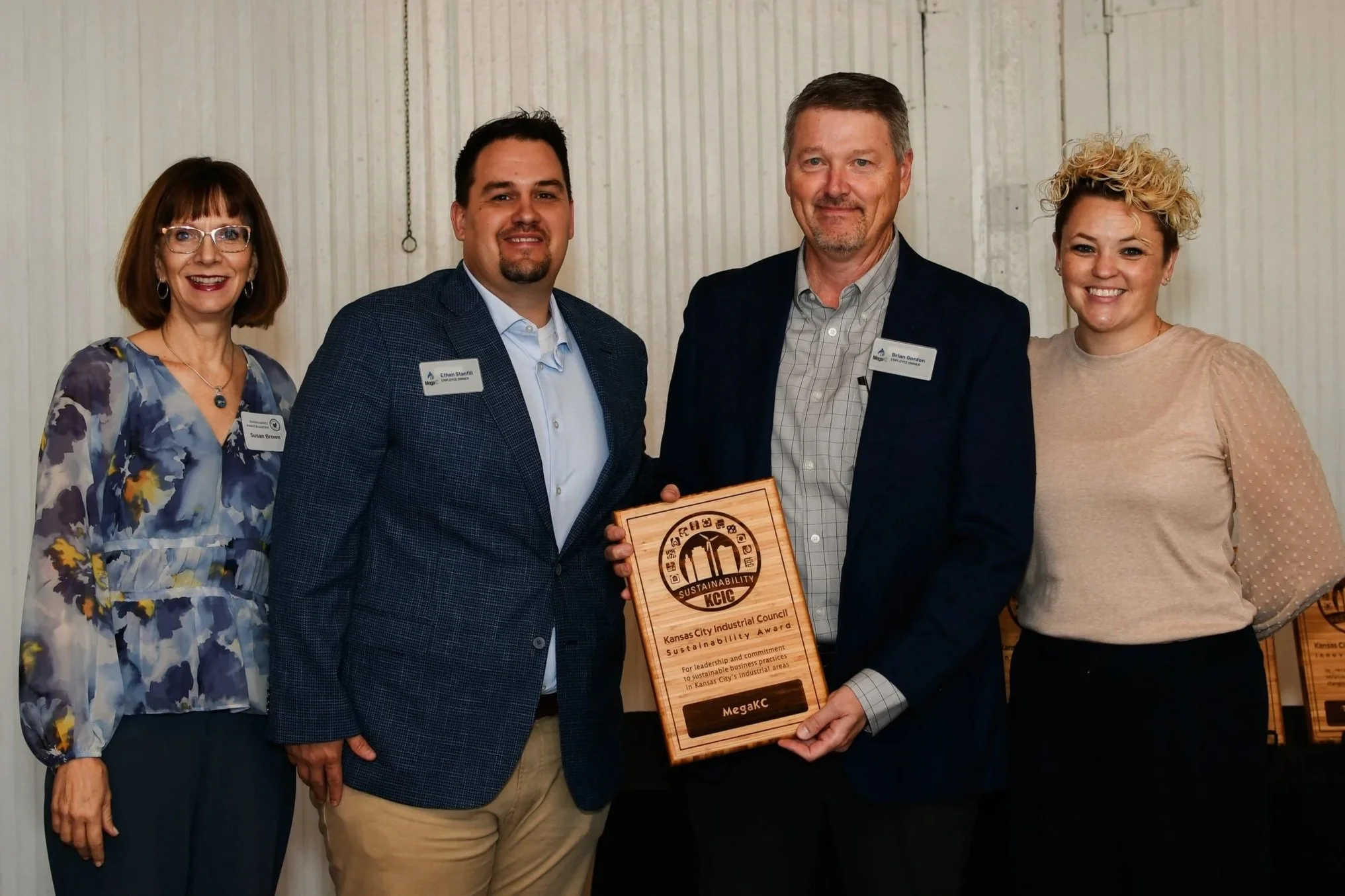
MegaKC: Solar Commitment Award
MegaKC, a merit-shop contractor specializing in water, wastewater, road, and civil infrastructure projects, earned recognition for its commitment to sustainability through solar energy. The company teamed up with Artisun Solar to install a 100-kilowatt rooftop solar system at their North Kansas City headquarters.
The system was projected to save the company nearly $13,000 annually in electricity costs, adding up to more than $570,000 in savings over the system's lifespan while offsetting approximately 2,425 metric tons of CO₂ emissions. MegaKC approached solar power as both a strategic business decision and a community-minded initiative that supported more green infrastructure projects, setting a leading example for other businesses in North Kansas City. CEO Brian Gordon and Vice President Ethan Stanfill accepted the award.
Evergy: Urban Heat Island Project
Evergy received recognition for its Urban Heat Island Project, demonstrating how utilities could offer nontraditional solutions to support customers and neighborhoods, especially those disproportionately affected by climate-related challenges.
The project aimed to lessen urban heat in the Northeast Kansas City area near Independence Avenue—a community identified as highly vulnerable to elevated temperatures—while promoting public health, climate and economic resilience, environmental justice, and community building. Research was conducted in collaboration with KU, UMKC, and MARC to create heat maps using car-mounted sensors and satellite imaging to pinpoint areas of greatest need. Analysis identified permeable surfaces suitable for tree planting, while impermeable areas were targeted for alternative solutions like cool roofs.
Community engagement was central to the initiative. Evergy hosted multiple meetings at the Chamber of Commerce on Independence Avenue, inviting residents to co-create the program and provide input on neighborhood needs and priorities.
Over the past two years, Evergy planted more than 900 trees, with the goal of planting at least 1,700 by the project's end, and installed four cool roofs, contributing to temperature reduction and improved environmental quality. To date, this totaled over $600,000 invested back into the community. Zian Trober, Product Manager II, and Natalie Gray, Manager of Energy Efficiency, accepted the award.
Innovation Awards
Two Innovation Awards honored businesses using innovative solutions for sustainability in the community.
Raptor Recycle and Transfer
Grandview-based Raptor Recycle and Transfer operated the largest waste transfer station in the KC metro area, with sustainability as a key part of their business strategy since opening their doors three years prior.
Their facility avoided the typical "trash mountain" approach common to most transfer stations, where trash often sat inside a building for days waiting to be sorted by diesel excavators, causing environmental odors and other issues. Rather than being dumped on the floor, waste at Raptor was sorted by electric cranes and deposited directly into waiting transfer trailers for shipment to a landfill.
The company partnered with Artisun Solar to install a 150-kilowatt solar system, which began producing clean energy in July 2025. Over its 30-year lifespan, the system was expected to offset nearly 3,800 metric tons of CO₂ while saving the company more than $19,000 annually in energy costs. By combining innovative design with solar power, the company redefined what a transfer station could be: efficient, responsible, and built for the future. Kit Starr accepted on behalf of Raptor Recycle and Transfer.
The Way Home and Kala
The second Innovation Award went to The Way Home, a local affordable housing non-profit, and Kala, a leader in building high-performance homes. Together, they demonstrated how durable, healthy, low-maintenance, and energy-efficient homes could and should be part of efforts to increase affordable housing in Kansas City.
On a formerly vacant lot in the Ivanhoe neighborhood of KCMO, this partnership built the region's first home that combined a commitment to affordability while also achieving Phius Passive House 2021 CORE certification—the most demanding green building standard in the world. The prototype informed plans for future homes throughout the neighborhood and beyond.
Passive homes offered a direct remedy to the worst side effects of many housing options for low-income families: the high cost of maintenance, an inherent "energy burden," and adverse health outcomes. The construction method required to meet passive home standards also resulted in a higher quality, more durable build, reducing future issues caused by cheap alternatives that hit a low price initially but led to expensive repairs later.
Built to require a fraction of the energy used by many homes in the region, this house allowed its owners to divert thousands of dollars that would have been spent on gas and electricity to other priorities in their lives. Another long-term benefit of a PHIUS home was its capacity to improve health outcomes due to the continuously circulated air and ERV system.
This range of benefits expanded the group of stakeholders beyond traditional affordable housing advocates, including a collaboration with Children's Mercy Hospital and their program that connected families with asthma or other environment-influenced health issues to healthier homes. Local government representatives and the Kansas City Design Center were eager to see an example of how affordable housing did not need to equal "cheap."
The public-private partnership between a community leader like The Way Home and industry leader like Kala highlighted both the need and solutions for an urban infill project that created sustainable, healthy, and responsible housing options for the community. Anna White, Director of Strategic Partnerships for The Way Home, and Cary DeKamp, Managing Director for Kala, accepted the award.
Stewardship Awards
The final two awards of the morning were Stewardship Awards, recognizing significant ongoing commitments to promoting environmental stewardship and sustainability in Kansas City.
Challenge Manufacturing and Evergy
Challenge Manufacturing and Evergy were honored together for demonstrating how programs that incentivize and encourage companies to invest in energy efficiency show that making good decisions for the environment is also often good for the bottom line.
For 40 years, Challenge Manufacturing had provided automotive components to the main car manufacturers in the Kansas City area. When maintenance manager Paul Biesemeyer noticed air leaking from the compressed air system they relied on heavily for their manufacturing process, he initiated a Leak Survey & Repair. More than 175 leaks were identified, and the repairs resulted in substantial energy savings of over 115,000 kilowatt hours. Challenge received over $12,000 in incentives from Evergy's Business Energy Savings Program and wrapped up a project to install variable frequency drives in their air handling units that controlled their energy and slowed the 20-horsepower motors on their HVAC system.
Evergy's Business Energy Savings Program supported organizations of all sizes in reducing energy use and improving operations through cost-sharing with energy-efficient upgrades. From lighting controls and HVAC improvements to refrigeration and fan systems, businesses benefited from cash incentives that made sustainable investments accessible and affordable across Kansas and Missouri.
To date, the program had helped businesses save over 23.6 million kilowatt-hours of electricity—equivalent to the annual energy use of nearly 4,000 homes. These results highlighted how local businesses were building a cleaner, more resilient energy future through energy efficiency while also strengthening their bottom line.
Evergy also fostered its commitment to community beyond energy upgrades by hosting community events for businesses, connecting them with experts and resources, and building partnerships that supported economic vitality throughout Kansas and Missouri. Paul Biesemeyer, Maintenance Manager, accepted on behalf of Challenge Manufacturing.
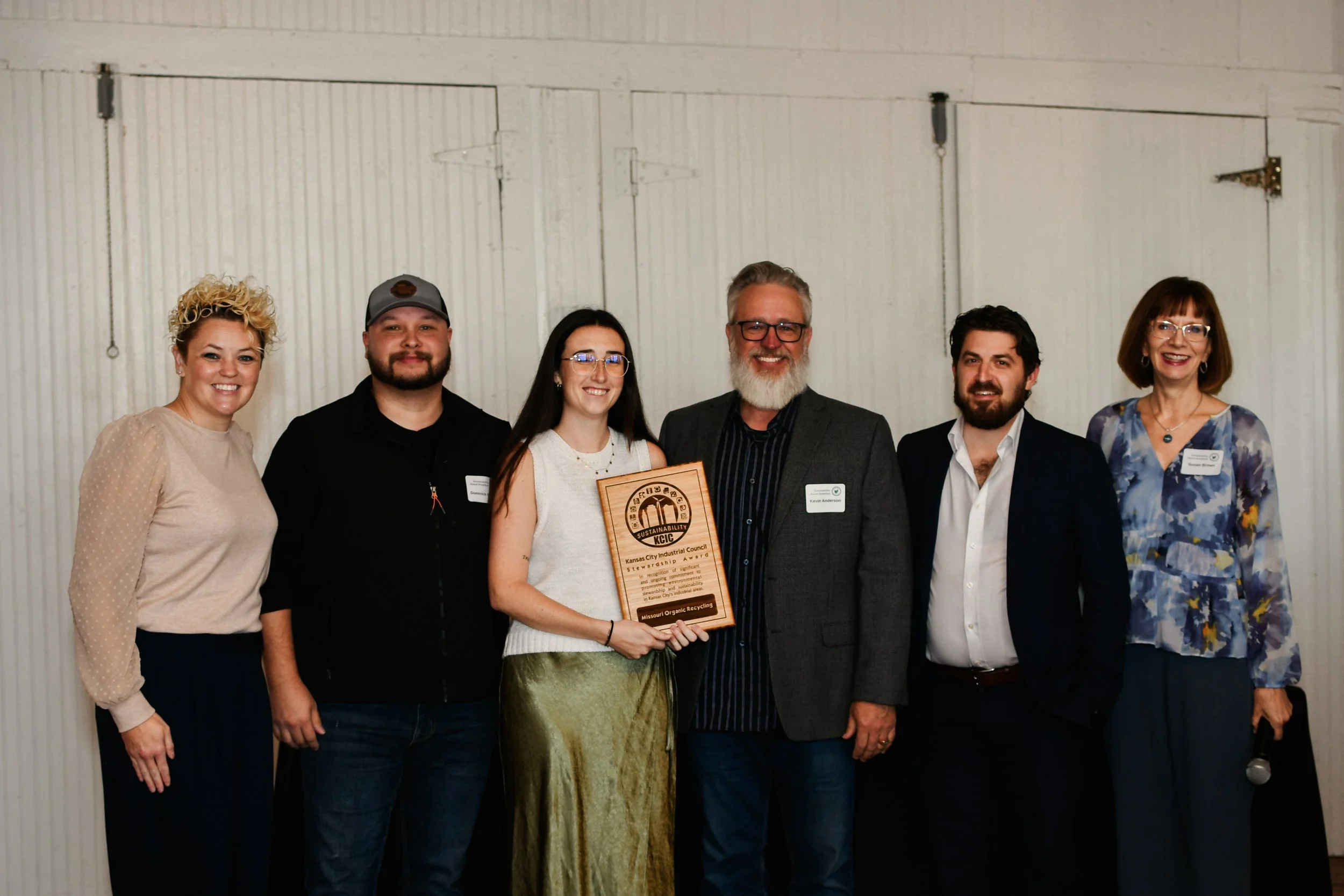
Missouri Organic Recycling
The final award of the morning went to Missouri Organic Recycling, a family-owned business dedicated to sustainability and environmental stewardship. For over 20 years, they had been committed to diverting food and yard waste from landfills, processing over 3.2 billion pounds of organic material into high-quality compost and mulch. Their operations not only reduced waste but lowered greenhouse gas emissions and supported sustainable agriculture.
Missouri Organic's success was built on strong community engagement. They worked closely with local businesses, municipalities, and residents to educate and encourage participation in their programs. Their scalability allowed them to continue growing, serving a wide range of customers, and contributing to Kansas City's green economy.
The award recognized Missouri Organic Recycling's leadership in helping to shift waste management in KC toward a circular economy. Kevin Anderson and Sarah Mayerhofer accepted the award.
A Legacy of Environmental Leadership
The 2025 Sustainability Awards demonstrated that environmental stewardship and business success go hand in hand. From solar installations saving hundreds of thousands of dollars to innovative housing solutions improving health outcomes, from urban heat mitigation projects investing over $600,000 in vulnerable communities to waste management operations processing billions of pounds of organic material—these award winners proved that sustainability is both achievable and profitable.
As KCIC celebrated 15 years of recognizing sustainable business practices, the diversity of this year's winners reflected the breadth of opportunity for environmental innovation across industries. Whether through energy efficiency upgrades, renewable energy adoption, circular economy practices, or community-focused environmental justice initiatives, Kansas City businesses continued to lead the way in creating a more resilient and sustainable future for the region.
These seven organizations set the standard for what's possible when businesses commit to environmental responsibility, demonstrating that investing in sustainability is indeed just good business.